

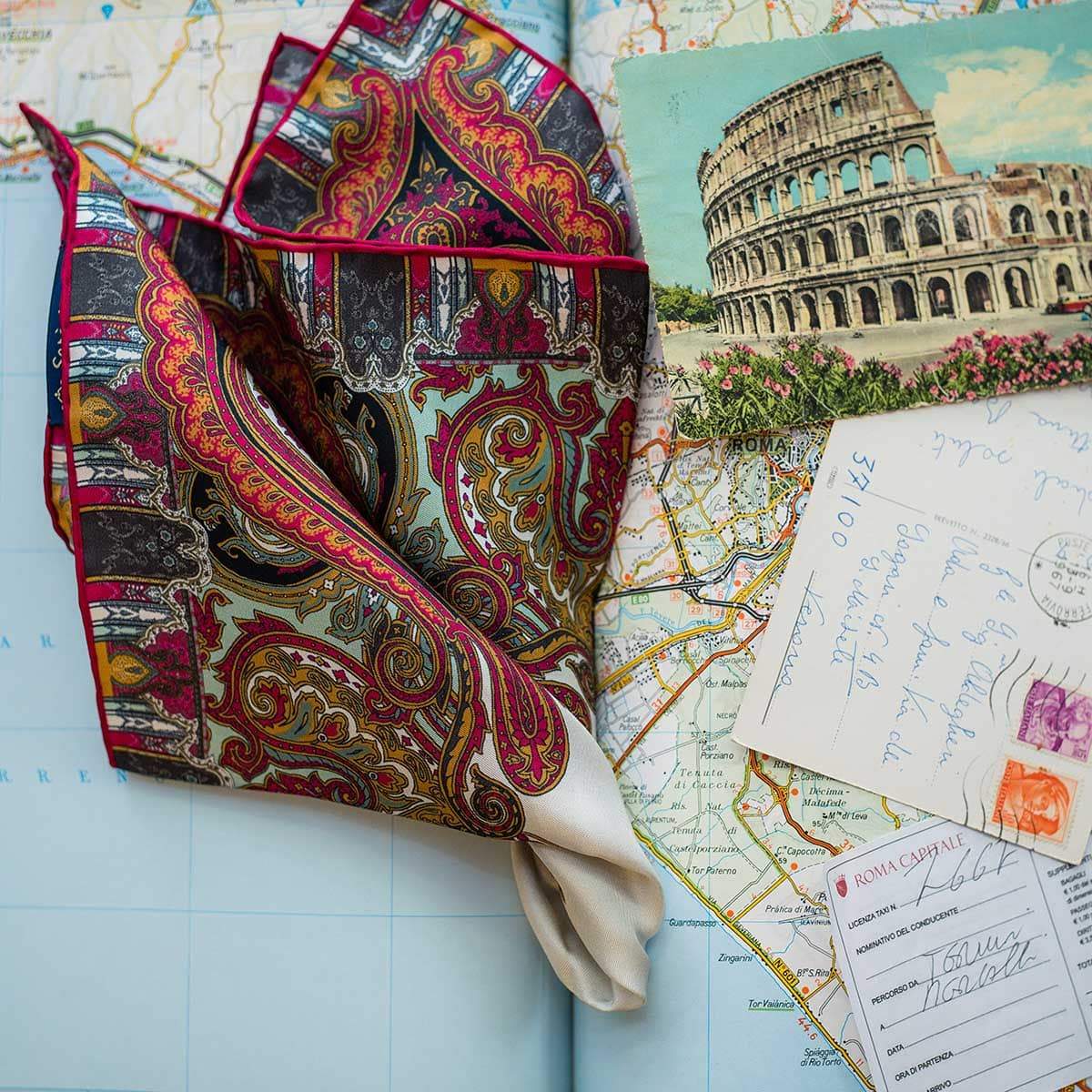
You often only see it on special occasions, although for a long time the pocket square was part of a complete outfit for men. You will also find terms such as cavalier handkerchief, pocket square or pochette, all of which describe the same thing: a handkerchief that is folded nicely and put into the lapel pocket. But how do you fold a pocket square correctly? We will show you four variations that you can easily recreate.
This is what you should consider before folding
Unlike a bow tie or tie, the pocket square is not necessarily part of a classic suit, but rather the finishing touch of good style. It should be colour-coordinated with the suit, often echoing the colour of the tie. You can often find both together as a set, which is particularly practical with eye-catching patterns. However, real gentlemen advise against wearing the ready-made sets.
Many men like elegant silk handkerchiefs, but pocket squares made of wool, such as tweed, are also popular with many men. You can choose a handkerchief that suits your taste, and cotton and linen are also possible. Ideally, you should iron your pocket square before folding it so that it is completely wrinkle-free. Only then will the folds really come into their own.
Before you start folding, you should wash your hands and choose a clean, dust-free surface, because dirt on the pocket square is an absolute no-go. Then it's time to decide on a folding technique - the choice is endless. We've put together the four most common techniques for you.
The classic triangle fold
The most common folding technique is the triangle. It is quick to do and can be easily refolded at any time if the pocket square slips.
- Place the pocket square in front of you with the front facing down and one corner pointing towards you. Now fold the bottom corner upwards to form a triangle.
- Now fold the left corner slightly over the middle. The corners should not touch.
- The last step is to fold the right corner to the left, similar to the left corner. Now you have to turn the pocket square once and you can put it exactly into the lapel pocket.
Simply folded as a rectangle
If you don't want to go all out and want to wear your pocket square in a minimalistic way, we recommend folding it at a right angle. Here, only the top edge of the pocket square sticks out from the lapel.
- Place the pocket square in front of you with one side facing you. Now fold the right side to the middle.
- Now fold the left side over the right.
- Finally, fold the top side down to the bottom third so that the handkerchief fits into your lapel pocket. You should put the pocket square in with the folded edge facing upwards.
Festive with the leaf folding
Are you invited to a wedding or are you even the groom? Then you can use the three-leaf technique, which is undoubtedly one of the more elegant folding techniques. Sometimes the term wave fold or ship fold is also used, both of which describe the appearance of the pocket square after folding.
- Lay the pocket square out in front of you with one corner facing you. Now place the bottom corner slightly offset from the top corner. The corners should not lie directly on top of each other.
- Now fold the left corner to the top right next to the two points. This way you have three points placed next to each other.
- Finally, the folded scarf must be carefully stored in the lapel pocket. To do this, fold the right side down to the left, so it becomes narrower and fits perfectly in the pocket.
top class: the crown fold
This folding technique is particularly elegant because the pocket square takes on the shape of a crown after folding. Therefore, the crown fold is recommended for very formal occasions.
- Place the pocket square in front of you with one corner facing you.
- Then fold the bottom half slightly offset from the top half so that the two corners lie next to each other.
- In the next step, fold the left side to the right so that the corner is on the far right next to the other two.
- Now fold the right side to the left so that the fourth corner is at the very front of the others. Done!
Where does the pocket square come from?
The first pocket squares appeared around 1830 in the Biedermeier period. They were still combined with riding clothes as an accessory. In the middle of the 19th century, frock coats were also fitted with breast pockets, so that it became fashionable to wear a pocket square in everyday life. In the middle of the 20th century, it was less popular; a tie and bow tie were enough for men. Pocket squares have only been popular again since the 1990s. In the recent past, they have also been accepted as a complete alternative to ties and bow ties.
There are dozens of folding techniques that can be used to shape the pocket square for the lapel pocket. Pins and elastic bands can also be used to hold the square in place. Safety pins can also be used, but they should be placed in a way that they are not visible.
Plain, striped, patterned? Silk scarves with a slight sheen or with a paisley pattern are particularly popular at weddings. Romantic, floral motifs are also popular. Very striking and high-contrast patterns should be chosen for evening wear for an event; for everyday wear, the colors should be very subtle. We recommend pastel shades, as these can be combined well for all occasions.
Are you looking for a stylish suit and matching accessories? We'll be happy to advise you and tailor your suit to your specifications. Just talk to us, we look forward to hearing from you!